First 50 programs selected
LMIC Health Digitalization Initiative — by OOMUSAccelerating the digital transformation of public health programs in low- and middle-income countries
OOMUS supports Ministries of Health, national programs, international NGOs and development partners with a sovereign digital infrastructure dedicated to beneficiary digital identity, campaign management and health system interoperability.
Full access to the OOMUS platform for 12 months — beneficiary digital identity, campaign management, sovereign citizen wallet and DHIS2 interoperability — for the first 50 selected programs.
Why OOMUS
Built for public institutions, not a startup
Nine structural guarantees that set a public digital infrastructure apart from a simple campaign software.
Sovereign digital infrastructure
Full hosting and control of your data on the infrastructure of your choice — no dependency on an imposed foreign cloud.
Unique digital identity
A deduplicated MPI registry that serves as the single foundation for every digital health service the beneficiary uses.
Native interoperability
Natively connected to DHIS2, OpenMRS, OpenLMIS and HL7 FHIR — no custom integration, no double data entry.
National-scale deployment capacity
An architecture designed from day one to grow from a pilot program to multi-region national coverage.
Offline-first operation
Enrollment, verification and field distribution work without a connection — automatic sync once the network returns.
High availability
Redundant infrastructure and a contractual SLA for critical services — no downtime in the middle of a campaign.
Enterprise-grade security
AES-256 encryption, multi-level RBAC access control and immutable logging of every action.
Real-time dashboards
Live operational visibility for decision-makers, field teams and funding partners.
Applied artificial intelligence
Coverage forecasting, anomaly detection and recommendations to optimize every campaign.
Context
Why this initiative?
Public health programs today need digital infrastructure capable of connecting beneficiaries, health workers, national systems and technical partners.
Health data fragmented across systems, regions and partners
Difficulty reliably identifying and authenticating beneficiaries
Lack of traceability and real-time visibility into campaigns
Persistent reliance on slow, unreliable paper-based processes
Difficult field monitoring for health workers and supervisors
Weak interoperability between DHIS2, DIGIT HCM and other existing systems
The solution
A sovereign digital infrastructure for your health programs
Digital Identity
Create a unique, secure digital identity for every beneficiary.
Campaign Management
Create, run and track national campaigns.
Digital Voucher
Distribute digital vouchers via QR code, SMS or WhatsApp.
Sovereign Health Wallet
Let citizens access their data and manage their consent.
Interoperability
Connects with DHIS2, DIGIT HCM, OpenMRS, OpenLMIS and HL7 FHIR.
Analytics & Intelligence
Operational monitoring, dashboards, AI and performance analysis.
Health programs covered
Use cases
One platform, nine public health programs
The same identity registry and the same OOMUS modules adapt to each program's specific workflow — with no separate platform to maintain.
Immunization
Enrollment at birth → digital vaccination card → automatic SMS/WhatsApp reminders.
Fewer missed appointments, real-time tracking of the immunization schedule.
Malaria (bed nets)
Household census → bed net distribution via QR code → field verification.
Full traceability of distribution down to the last mile.
HIV/AIDS
Confidential identification → longitudinal treatment tracking → ARV stock-out alerts.
Continuity of care even when a beneficiary switches health facilities.
Tuberculosis
Screening → enrollment in the DOTS protocol → treatment adherence tracking.
Early detection of treatment dropout, with alerts to field teams.
Nutrition
Malnutrition screening → distribution of nutritional supplies → growth monitoring.
Precise targeting of vulnerable households, with individual tracking over time.
Community health
Census by community health workers → referral to care facilities → field reporting.
Real-time visibility into community health worker activity.
Maternal & child health
Pregnancy tracking → child's digital health record → postnatal visit reminders.
Continuity of mother-child follow-up across several years, portable between facilities.
Universal health coverage
Enrollment of insured members → issuance of the UHC card → entitlement verification at point of care.
Reduced fraud and affiliation duplicates at national scale.
Health insurance
Subscription → claims management → reimbursement via the digital wallet.
Faster processing of reimbursement claims, fewer disputes.
Results
A technology already proven, not a concept
The LMIC Health Digitalization Initiative runs on the same OOMUS technical platform — not a prototype built for the occasion.
- Organization based in Dakar, Senegal, with a technical team dedicated to health information systems
- Same identity registry (MPI), same campaign engine and same sovereign wallet as the OOMUS platform
- Compliant with the open DHIS2 and HL7 FHIR R4 standards and the OpenHIE reference architecture
beneficiaries already enrolled via OOMUS technology
An architecture sized for scale
Transformation
Before / after OOMUS
Without OOMUS
- Paper registers and manual re-entry
- Duplicate and fraudulent beneficiary identities
- Manual reports, consolidated weeks late
- Poor visibility into field activity
- No unique digital identity for beneficiaries
- Limited interoperability between existing systems
With OOMUS
- Unique, deduplicated digital identity (MPI)
- Instant verification via signed QR code
- Real-time dashboards and reports
- Geolocated field tracking, offline-compatible
- Shared MPI registry across programs and facilities
- Native interoperability with DHIS2, OpenMRS, OpenLMIS, HL7 FHIR
Launch offer
A complete license to get started with OOMUS
Join the first 50 partner programs of the LMIC Health Digitalization Initiative directly and get full access to the platform.
- Full access to the OOMUS platform — every feature included
- Sovereign deployment & dedicated support
- Continuous updates, no hidden costs
per program / 12 months
Join the initiativeInfrastructure costs (servers, storage, network, security) remain the responsibility of the beneficiary program or its implementation partner.
Time remaining before the launch offer closes
Included in the license
One license, the entire platform
No hidden paid modules and nothing to negotiate separately — everything is included from day one.
Deployment & implementation
From application to Go Live, in a sovereign environment
OOMUS is deployed directly on your organization's own infrastructure — on-premise or sovereign — to guarantee security, compliance and institutional control. A structured seven-step journey, from initial diagnosis to ongoing support.
Diagnosis
Digital maturity assessment and mapping of existing systems.
Installation
Infrastructure deployment on the chosen environment, on-premise or sovereign.
Configuration
Setup of modules, roles and workflows specific to the program.
Integration
Connection to existing systems via standard open APIs.
Training
Onboarding for technical teams and field agents.
Go Live
Production launch and start of enrollment operations.
Support
Ongoing support, updates and dedicated technical assistance.
Architecture
How information flows, from citizen to ministry
Security
An enterprise-grade security architecture
Every piece of health data is transmitted and stored under guarantees that meet international standards.
Product preview
The platform in action
Detailed screenshots available on request — a preview of the platform's main modules.
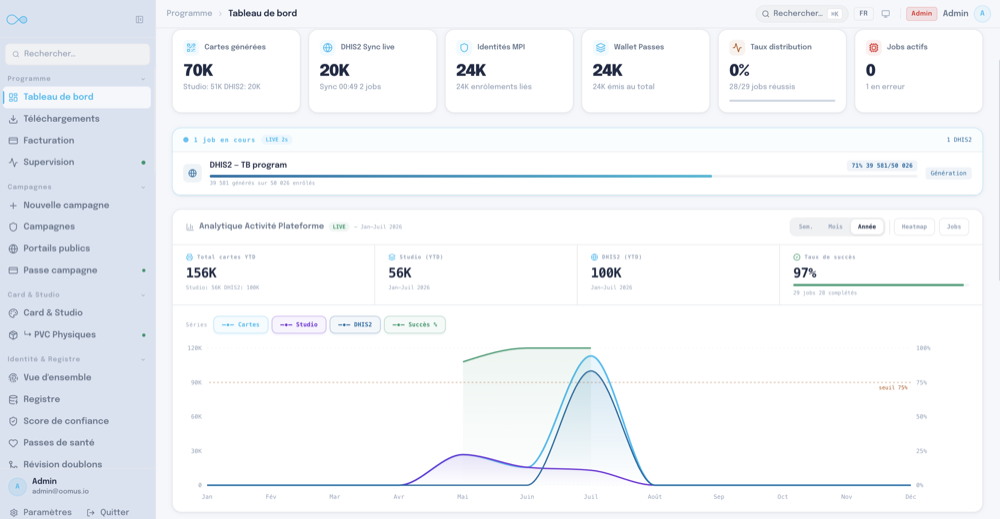
Dashboard
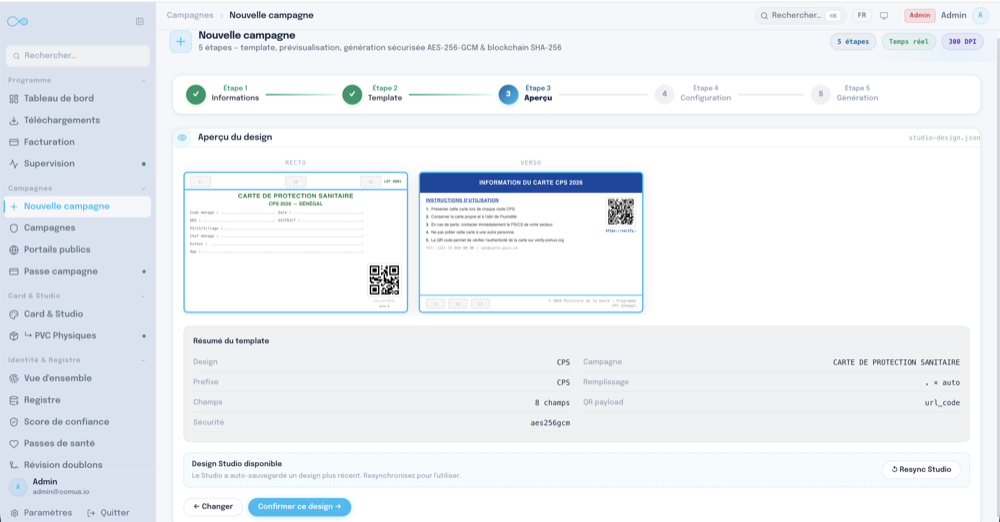
Campaign Management
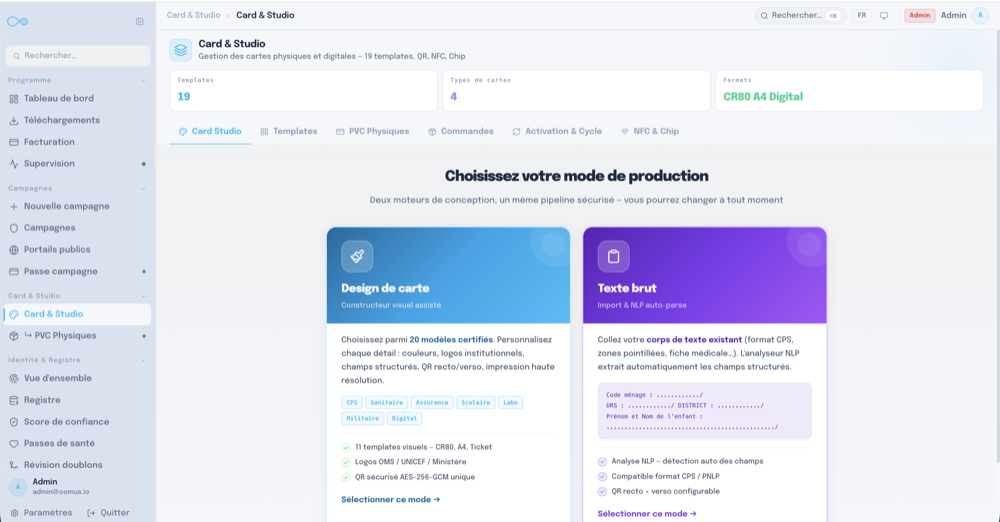
Card Studio
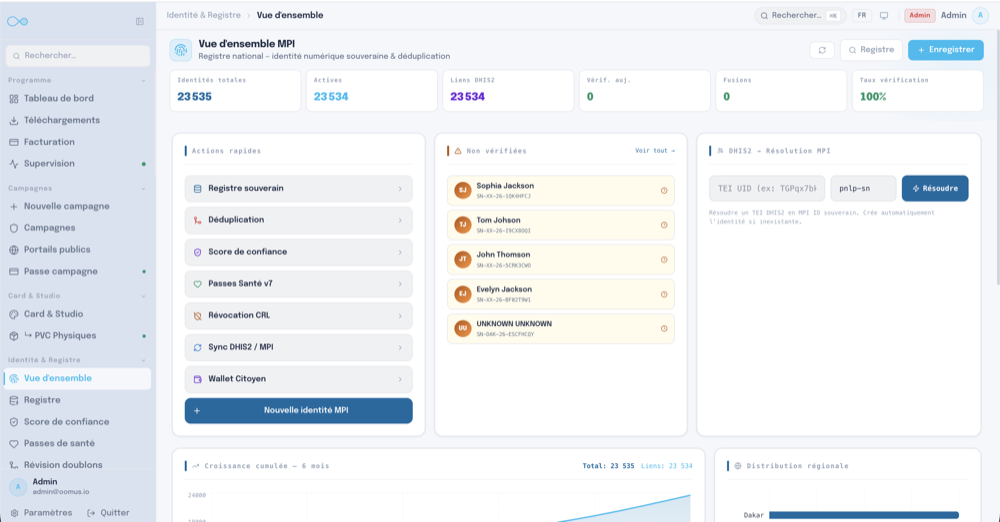
MPI Registry
Sovereign Wallet
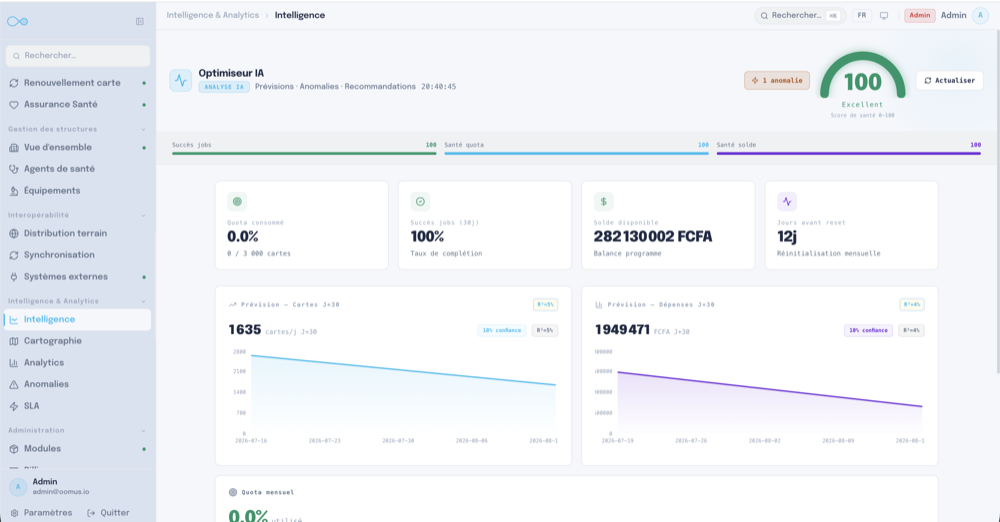
Analytics
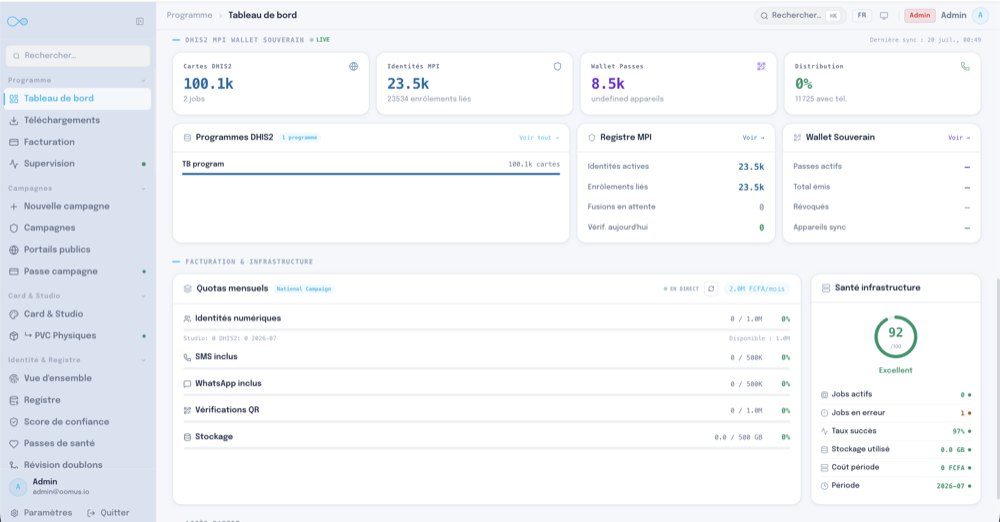
DHIS2 Integration
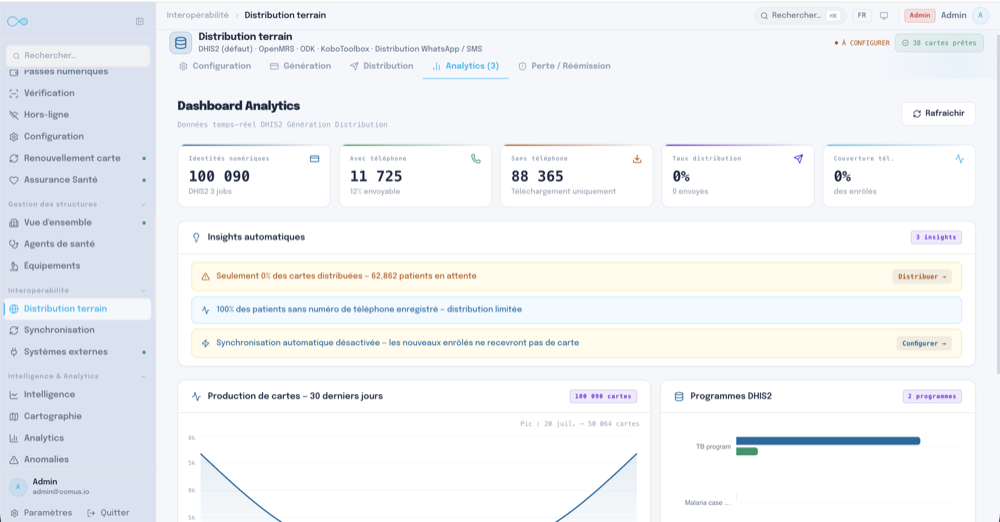
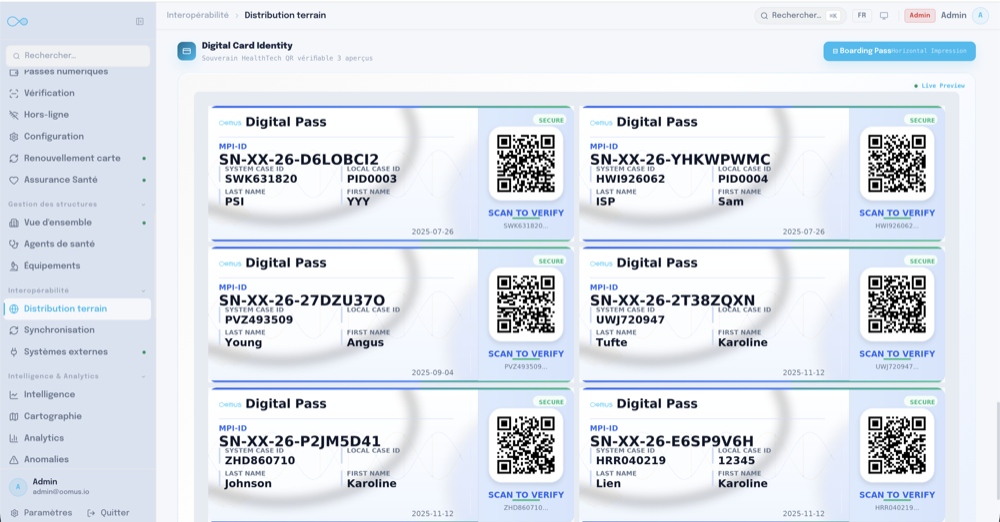
Field Distribution
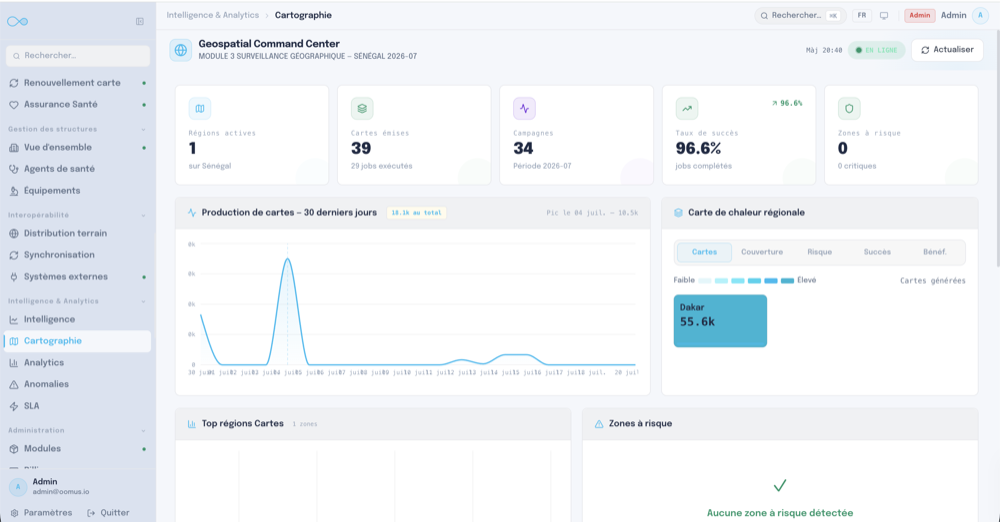
Geospatial Command Center — real platform preview
Regional presence
An ambition at the scale of West Africa
The Founding Cohort of 50 programs is the first step of a broader regional ambition.
Why now
This is a structural moment, not a cyclical one
Four converging dynamics are making health system digitalization a priority, not an option.
Digital transformation
Donors and governments are accelerating the digitalization of essential public services.
Universal health coverage
A reliable digital identity is a prerequisite to enroll and track every beneficiary.
Pandemic preparedness
A single identity and traceability registry speeds up the response to health crises.
Climate change
Climate-driven population displacement demands a portable, verifiable identity.
FAQ
Frequently asked questions
Does OOMUS replace DHIS2?
No. OOMUS complements existing systems by adding a specialized layer for digital identity, beneficiary management and campaign digitalization.
Does the data stay under national control?
Yes. OOMUS favors sovereign deployment, letting organizations keep control of their infrastructure and their data.
Can OOMUS be deployed at national scale?
Yes. OOMUS supports both single-program deployments and national-scale deployments.
Where is health data hosted?
OOMUS supports sovereign deployment models, including On-Premise deployment directly on the organization's own infrastructure.
Are SMS and WhatsApp included?
Communication services are billed separately based on usage.
What happens after the launch offer closes?
The 50 Founding Cohort spots are reserved until October 20, 2026. After that date, new programs join the platform under standard pricing terms — available on request from our team.
How is my data protected?
AES-256 encryption of identities, TLS for all transport, role-based access control (RBAC) and immutable logging of every action — see the Security section above for full details.
How does migration from our current systems work?
Existing data is imported into the MPI registry with automatic deduplication. A technical team supports the integration phase without interrupting ongoing operations.
What support is included with the license?
Technical support, deployment assistance and team training are included in the institutional license — no separate support package to negotiate.
How are platform updates managed?
Updates are included in the license and deployed without interrupting critical services. Major changes are communicated to the program's technical teams in advance.
Is the license renewable?
Yes. The institutional license covers 12 months and is renewable — renewal terms are communicated ahead of the expiration date, with no automatic commitment.
Join the initiative
Ready to get started with OOMUS?
Submit your organization's application, or start with a free assessment of your digital maturity.